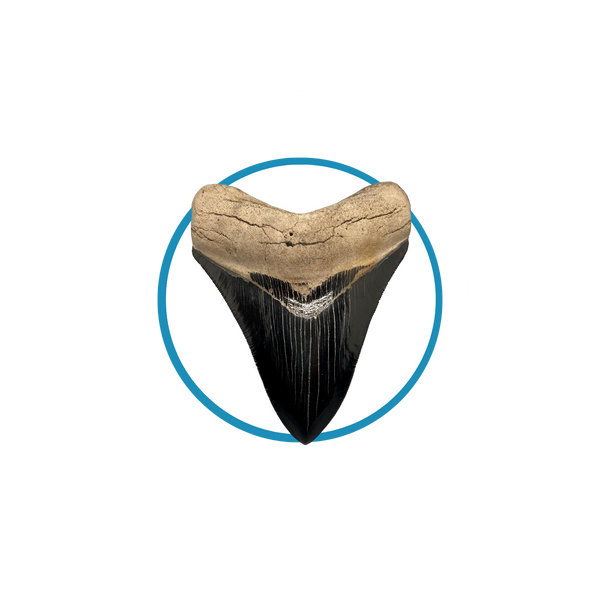

Approximately 100 million years of evolution of the marvelous Megalodon Shark explained briefly by Steve Alter.
Join us in this adventure!
The evolution of the megalodon shark goes back more than 100 million years. In nature it's rarely as simple as something "appearing" out of nowhere. A complex and lengthy process of evolution is behind the scenes of almost everything we see and this magnificent lineage is no different. Here we'll briefly touch on the species that came before the megalodon and how the evolution occurred.

The first definitively known ancestor of the megalodon was a mid-size shark named Cretalamna appendiculata which first appeared in the Cretaceous more than 100 million years ago. This shark was probably the most successful of the entire lineage not really changing for around 50 million years!
However the much larger Otodus obliquus did branch off from the Cretalamna in the Early Paleocene. The obliquus grew to sizes of at least 10 meters with a much thicker and robust tooth structure. This species was not serrated.

Visit our Carcharocles auriculatus collection here
Serrations began to appear on populations of Otodus obliquus during the Early Eocene and the overall size of the shark began to shrink. This marks the first transition into the famous Carcharocles lineage and is known as Carcharocles aksuaticus.
Fairly rapidly (over only a couple million years) this shark developed fully serrated cutting edges - possibly coinciding with the evolution of whales from land mammals. This species is known as Carcharocles auriculatus.
Throughout the Eocene the auriculatus gradually grew larger and larger as whales continued to evolve. By the end of the Eocene the teeth are known by many names (Carcharocles sokolowi/poseidoni/auriculatus). Whatever you want to call them they grew to almost double the size of the earlier Eocene versions of this shark.
Visit our Carcharocles angustidens collection here

Visit our Megalodon Collection - Click Here
During the Oligocene the Carcharocles continued to evolve and this species is known as Carcharocles angustidens. It really is quite similar to the Late Eocene sokolowi/poseidoni but not a lot of Oligocene fossil formations are known to produce this stage.
During the Miocene the Carcharocles teeth began to slowly (and not consistently) lose the sidecusps. This iteration is known as Carcharocles chubutensis. However the Late Miocene would see the greatest change in this lineage.
Coinciding with an explosion in whale evolution (new species growing to much larger sizes) the Carcharocles megalodon evolved. The megalodon was by far the largest shark to ever live. Luckily there are amazing fossil deposits worldwide that yield fossil megalodon teeth so we can clearly see the evolution of these teeth over time.
The megalodon lived until the Early-Middle Pliocene when the evolution of the modern Great White and Orca (Killer Whale) simply outcompeted the juvenile megalodons for food and the 100 million years of evolution came to an end.
Steve Alter and the MegalodonTeeth.com team.